Will 2030 be the year that humans meet aliens?
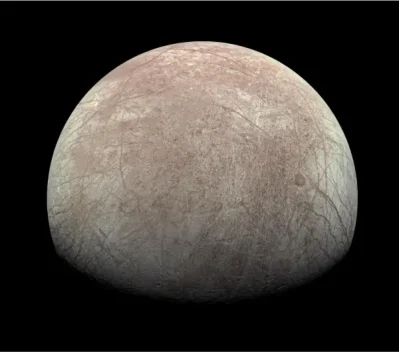
In 2024, the National Aeronautics and Space Administration (NASA) launched a mission called the Europa Clipper. Its target? Europa, one of Jupiter’s 95 officially recognized moons and the sixth-largest moon in our solar system.
But Europa also holds a secret: the moon is covered in a thick, icy shell, leading scientists to believe that a vast ocean lies beneath its surface—an ocean which could hold more water than all of Earth’s combined.
However, the main difficulty in researching Europa isn’t reaching the moon itself, but rather the large radiation belts created by Jupiter’s rapid rotations and volcanic emissions. These radiation belts are hazardous structures that trap charged particles, causing a highly radioactive environment that could kill a human in just a few days. Unfortunately, these intense amounts of radiation are also highly dangerous to satellite systems and spacecraft, resulting in greater difficulty when drafting missions to Europa.
To combat this obstacle, scientists developed the Europa Clipper. Similar to the 19th Century clipper ships, which “clipped” across oceans and sailed large distances, this spacecraft will “clip” past Europa every few weeks. In total, the Europa Clipper is estimated to perform nearly 50 flybys, during which time it will use nine instruments designed to map Europa’s surface, determine its composition, and calculate its ice shell’s thickness, all in search of potential alien lifeforms.
The Europa Clipper is on track to reach Europa in April of 2030, and while the moon is not habitable for humans, scientists speculate it contains the necessary components to sustain life.
So, the big question remains: Will we find aliens?
Maybe, and it’s entirely possible, but they most likely won’t look like the ones portrayed in movies. If life currently exists on Europa, it’s likely to be microbial or simple organisms found on the bottom of the theorized seafloor.
All that’s left now is to watch as the Europa Clipper slowly journeys 1.8 billion miles—about the same as circling Earth 72,285 times—on its way to Jupiter, as we wait to see what discoveries it will reveal.
What do you think we’ll find?