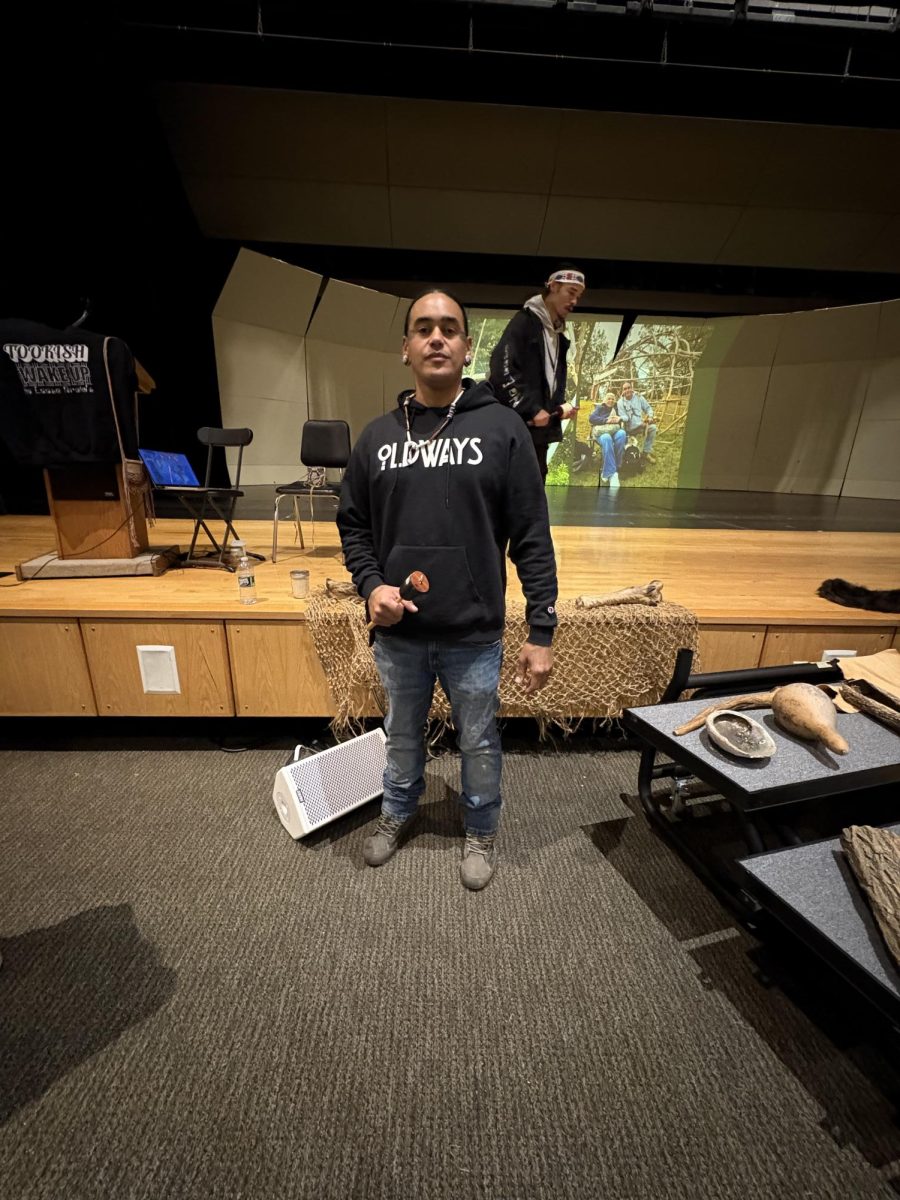
On Friday, November 21, 2025, at around 9:45 a.m., students at Minnechaug Regional High School received a presentation from a special guest Andrae Gaines, a member of the Nipmuc tribe. The event was hosted by the Student of Color Alliance.
Gaines began by explaining that Nipmuc means “fresh water people.” Their creator placed them near the water to care for it, and the Nipmuc have lived in this region for over 12,000 years. Over time, their land has slowly been taken, and today the tribe hopes to reclaim what they have lost.
The Nipmuc have a traditional way of greeting each other through songs, some of which are as old as their history itself. Gaines shared foods like wechinam (cornmeal), passed down through generations and used to sustain families during pimpinae, or winter. He also showed students a traditional rattle, the first sound Nipmuc babies hear, which connects back to their creation story. The tribe follows one creator, known as “the Great Mystery.”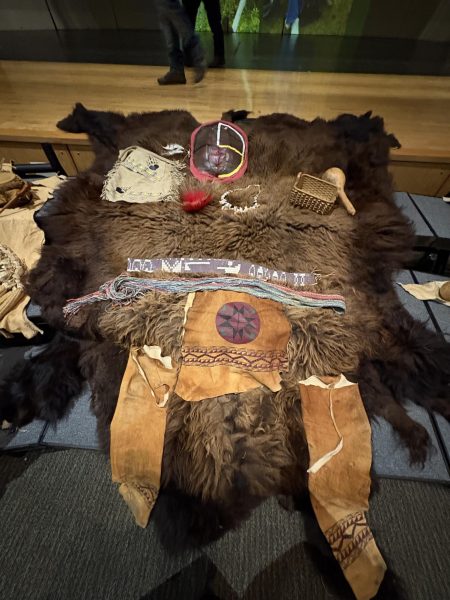
Today, the Nipmuc community is shrinking. They now have zero first-generation speakers of their language and only 2,600 members left, about four percent of what they once had. As elders pass away, their teachings, practices, and language become harder to preserve.
Gaines spoke about historical challenges faced by the tribe. In the 1920s, Chief Cisco was photographed wearing a suit because the Nipmuc were forbidden to speak their language or hold ceremonies until 1978. They kept their culture alive in secret, often practicing in church basements.
The tribe is matriarchal, led by women who were referred to as life givers. Men are referred to as lifetakers because hunting required taking the lives of animals. He also mentioned tiddle heads, one of their traditional foods.
The Nipmuc are Indigenous to this region, and many artifacts can still be found in places like Rhode Island and Boston, which were once major ports involved in the slave trade. A central belief in Nipmuc natural law is that water gives life, but can also take it away.
Gaines explained the depth of their language, noting that Nipmuc words cannot be reduced to a single English definition. Each word carries a story passed down over generations. When he asked Minnechaug students what Minnechaug meant, most guessed “blueberries” or “land of blueberries.” In reality, the word refers to roots used for different medicines.
He also showed a turtle shell, explaining that the rings represent the 12 new moons, marking each full moon as a time of harvest.
“What’s the harvest coming up, does anyone know?” he asked.
“Thanksgiving!” students shouted.
“Yeah,” he replied. “That’s what they call it now. But it was once called the Great Swamp Massacre.”
The harvest season depends on the earth’s balance and sustainability. It brings socials and powwows, where tribes visit each other’s lands and share items such as sassafras (also called sasaunckpamuck) a blood-cleansing root, deer (tuk/attuck), medicine (mosquetu), and cranberries (sasquinuch), which help fill in wetlands so they can later be built on. During these events, they wear their regalia, which is not a costume, but a reflection of who they are.
Gaines ended the presentation with one of the tribe’s call-back songs. Students participated enthusiastically, grateful for the opportunity to experience and honor Nipmuc culture.
*Their history is limited, so some of the words translated may be incorrect *